 LEGENDS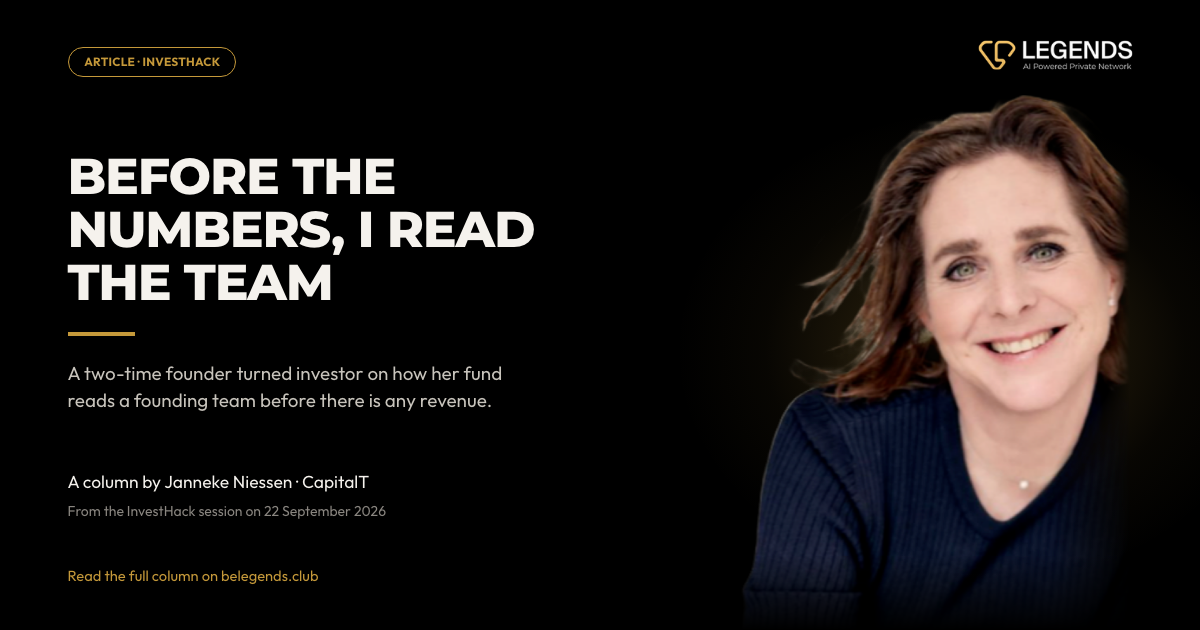
It was a Friday afternoon and I had two founder calls back to back. A few minutes into the first one I caught myself thinking: please, kill me now. I got zero energy from it, but I told myself not to be too harsh. It was Friday afternoon, and maybe it was me, so I sat through it.
The second call was the opposite. The founder had so much energy that thirty minutes were not enough, and I asked whether we could keep going. Somewhere inside that conversation I decided I wanted to invest. We still did the work afterward: the data room, our technical due diligence, our team due diligence. That process can go really fast with us. The fastest we have done is four days between the first call and transferring the money. Normally it takes a little longer, but when a deal is hot, that is how fast we can go.
She has pivoted since, and she is doing incredibly well. Great founders adapt when the market changes under them.
I invest before there is revenue, and that afternoon is most of the job. Later the conversation is about numbers and KPIs. Before revenue there are no numbers to read, and the bet is on the founders.
What there is to read before revenue
We invest in applied AI, climate tech and physical AI, and we do a bit of biotech. I look at the market, whether it can grow much bigger or become a new category. But when great founders start something and it does not work out, they pivot to something else. The idea changes. The founders are what I am backing.
Venture capital is full of bias. People tend to invest in people who look like them, who come from the same networks and went to the same schools. There is a lot of pattern matching, and our picture of what a great founder looks like is largely defined by what we see in the media. A lot of amazing founders sit outside those profiles.
So we read teams in a more data-driven way, across a few areas.
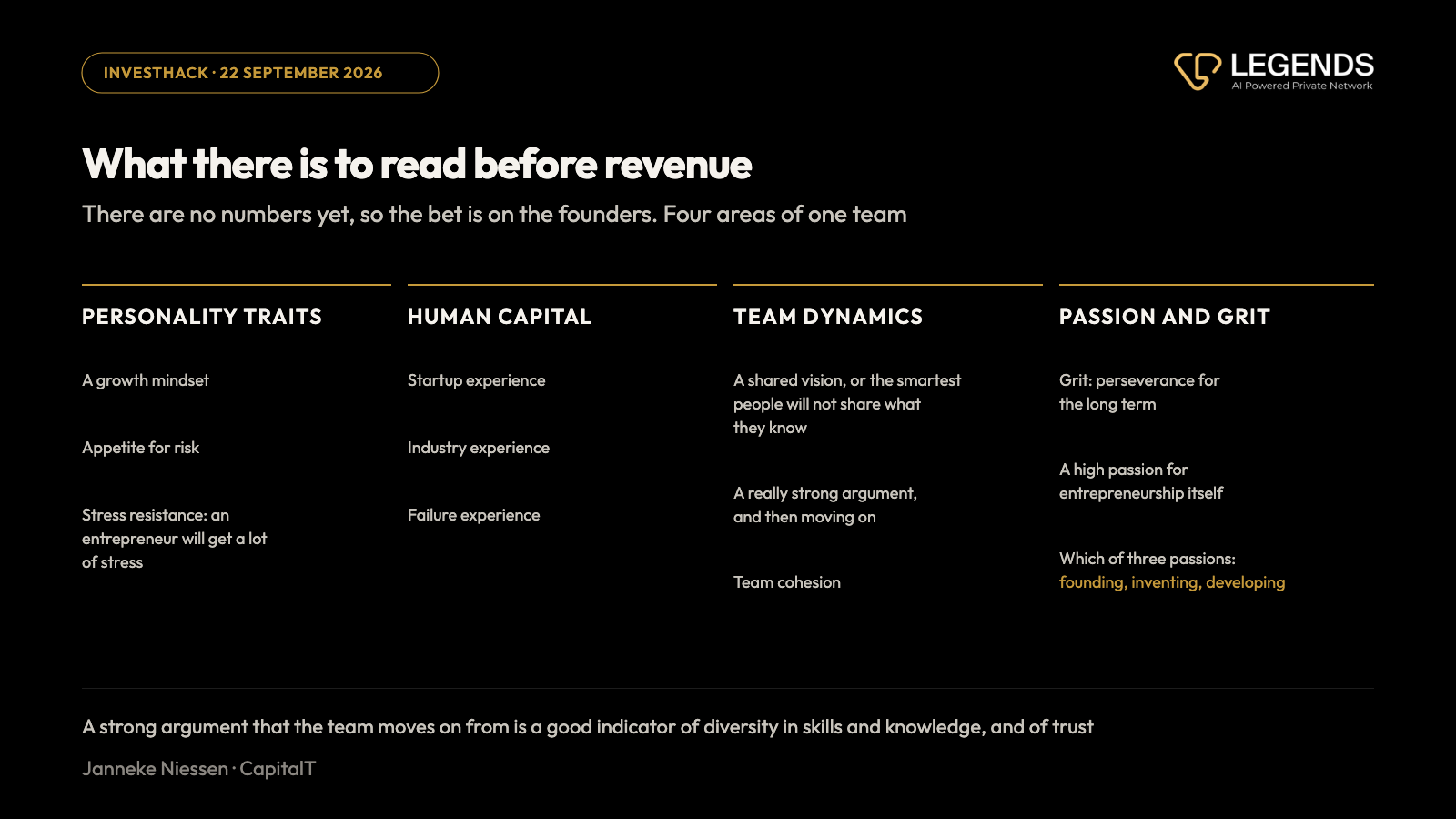
Personality traits. Does this person have a growth mindset? What is their appetite for risk? Are they stress resistant? An entrepreneur will get a lot of stress.
Human capital. Startup experience, industry experience and failure experience.
Team dynamics. First, a shared vision. Without one, the smartest people in the room will not share their knowledge with each other, which makes the room useless. Second, whether a team can have a really strong argument and then move on. That sounds negative, but it is one of the most important things in a well-functioning team: it is a good indicator of real diversity in skills and knowledge, and a good indicator of trust.
Passion and grit. Grit is perseverance for the long term. Passion we look at in layers. Without a high passion for entrepreneurship itself, founders are likely to burn out or stop altogether. Someone who starts a company for fame or fortune tends to burn out sooner, and both are unlikely outcomes anyway.
Then there are three kinds of passion. Some founders have a passion for founding. They love the first phase, and then they want to move on, put someone else in charge or sell. Some have a passion for inventing and want to work on the product or the service; building a team or growing a culture interests them much less. And some have a passion for developing, which means building that culture and growing past the startup phase into a much larger company.
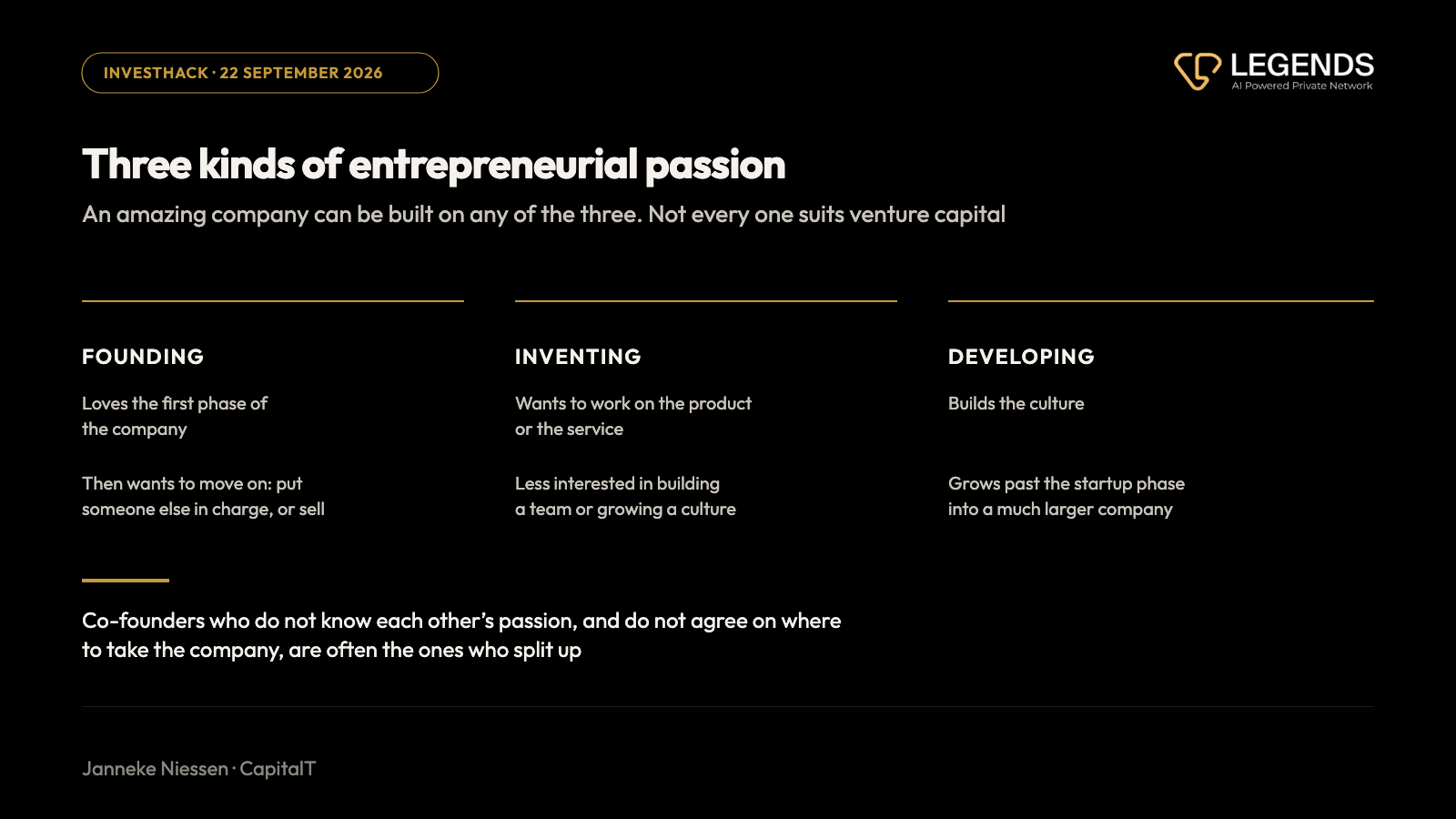
An amazing company can be built on any of the three. Not every one of them suits venture capital, though, because venture capital expects a certain pace and a certain growth rate. What matters to me is whether the co-founders share the same passion, or at least agree on where they want to take the company. Short-term and long-term decisions both follow from it. A team that wants to stay small makes very different choices from a team that wants to build something very large, and when co-founders do not know each other’s passion and do not agree on the destination, that is often why they split up.
None of this tells me in advance which company will make it.
The one time we followed the hype
At this stage a lot of companies will fail. Some are too early, some do not execute as well as expected, for some the market changes.
What we try not to do is follow hype. Many times a deal was really hot, we did not see it, and not investing turned out to be right. There was also one case where we did follow a little bit of hype, and it was a mistake. Luckily it was only a small ticket. That is when we decided: we always stick with our own assessment. If we do not see it, we do not invest.
The other thing we took from failures came back to passion. A few times we have seen founders with a passion for inventing for whom venture capital was simply not a match: the growth expectations were not what they wanted. So we stick more closely to the facts we have. That is probably the one thing we changed.
What I see from the other side of the table
Investors often do not have the founder’s domain expertise. The decks that land with me are very simple, almost too obvious in the founder’s eyes: what problem is being solved, why this team, why now and how.
When an investment bank writes to us on behalf of a company at pre-seed, seed or even Series A, I wonder two things. How can the company afford it? And why are the founders not raising themselves? At that stage we expect founders to fundraise on their own, and a bank in the middle disqualifies the company from our process.
An email that opens with “Dear Sir” I delete without reading. A founder who does not care who I am gives me no reason to care who they are.
Investors get very excited about companies that are not raising, because then they can try to be the first. That is the reason events matter, because the meeting in person and the first impression happen before the raise.
When we pass on an inbound company, we say only that it is not a good fit right now. As a founder I know how frustrating such a lousy explanation is. But if we start explaining, the founder always knows more and will argue with our reasoning, and that does not change our opinion. Once we have met, we do explain what we see and why we are not investing, because the founder invested time in meeting us, and we pay that back.
Two companies, and the dark side
I started my first company at twenty-three, only two years into working. A colleague and I looked at what we were doing and asked each other whether we could do it better, differently. Then we just went for it.
Being an entrepreneur was not cool at all back then. People told me not to give up my career; I had a mortgage. Nobody thought it was a good idea except me. For me the worst case was clear: paying back the loan I had taken from my parents, a slightly bruised ego and hopefully a lot learned. That is the advantage of starting young, when there are few responsibilities and not much fear. If I had known upfront every difficulty and every setback, maybe I would not have started.
We built that company internationally, with offices as far away as South Africa. My second company came out of a conversation with a client: it started as consultancy, did not scale and became a technology company with offices across Europe. When we were approached about an acquisition, fundraising was hard, and a sale let us sell part of our shares and keep building. So we did it.
After I left, I kept coming back to the first check. Somebody saying they love the idea and will put money behind it means a lot, and I was already doing that for others as an angel. A venture capitalist also gets a real say in which companies get to grow: eight of the ten most valuable companies in the world started with venture capital. Being an entrepreneur is the best thing there is, but I know what it takes, and without an amazing idea I would not do it again. So this was my next best thing. That is how I went over to the dark side.
People shaped that path. My parents always gave me the feeling that I could achieve anything I wanted, as long as I worked really hard for it, and that gave me the confidence to start. Later it was Neelie Kroes, who used to be a Dutch politician in Europe and was quite famous; Roam Like at Home is one of her policies, and most of us live with it every day. As an early entrepreneur all I did was work on my company, and that was right. When I met her, we talked about what would make entrepreneurship in Europe better, and she said: “There are a few things we can do in Brussels, there are a few things I can do, but what are the things you can do?” That question pulled me outside my own company, into diversity in tech and into speaking about what politicians and founders could each do.
What I would do differently now
Something I learned while building a company came from watching American competitors. We beta-tested every new feature before sending out a press release saying it was ready. They sent out a press release when a feature went on the roadmap. Clients saw them as far ahead of us, while in reality we were more or less the same. Perception is reality, and how people see a company is something the company can influence. If I built a company today I would work on that from day one. I would also raise more money, because we raised far too little, and my deck would be far less technical.
Venture money comes with growth expectations, and the founder loses part of their say in the company. With the tools available today, more and more companies do not need it at all. That is sometimes bad for us; with my founder hat on, I think it is great. If I could build without venture capital money, I would.
So what is defensible when features are this cheap? We invested in a company that grows wood in a lab. Its patents, the knowledge inside the company and the results it has already produced are things the next version of Claude will not replace. The same goes for a company we backed with a six-meter drone for forest thinning, which has so much know-how and patented work in it that it is very defensible. Pure software without anything like that comes down to distribution: being first, being number one, letting the brand win, the way it does for Legora and Lovable. My worry about some companies making a lot of money quickly is that they can lose it just as fast.
Someone at the session said that not many VCs look like them. More and more investors look beyond that; our portfolio is a big mix of men, women and people of color, and we like founders who do not match the stereotype. Women often get questions about the past, where men get questions about the future. The past has already happened, and I would turn such a question around and talk about the future. After that it comes down to results. When they are there, investors show up at the door, and it is fun to say no to the ones who treated a founder badly before.
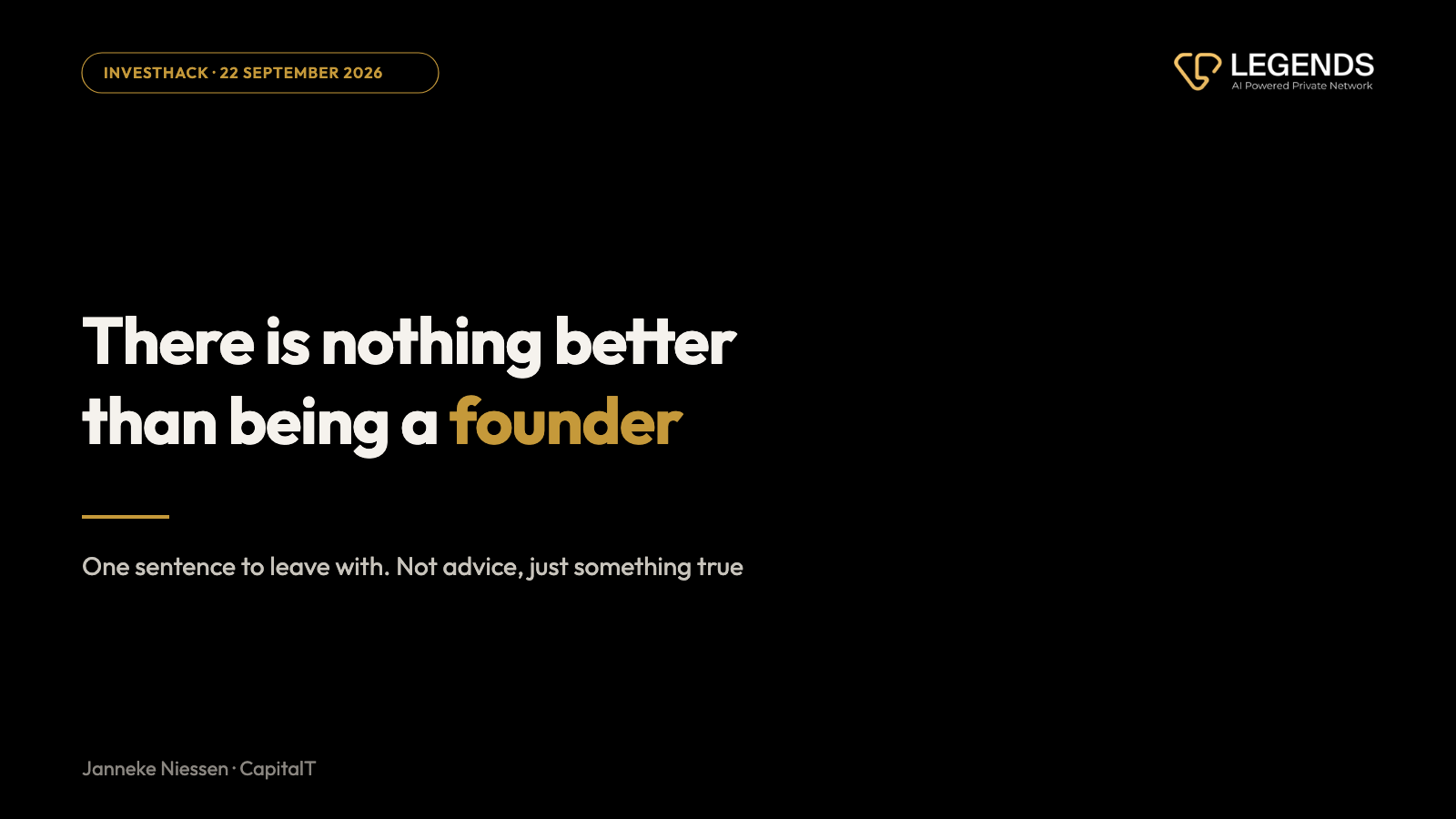
At the end of the session I was asked for one sentence to leave with. Not advice, just something true. There is nothing better than being a founder.
Janneke Niessen spoke at a Legends session on 22 September 2026. She is Founding Partner at CapitalT in Amsterdam and founded and exited two technology companies before she became an investor. The open session ran first; the closed room afterward was for members only, and membership starts with an interview.
About Legends. Legends is an invitation-only, AI-powered private network for the people who move markets — founders, operators, family offices and investors who prefer to build among peers rather than crowds. One network, three clubs: the Global Investors Club, the Global Founders Club and the Global C-Level Club. Different rooms, one standard to enter.
Legends is not an investment platform. We do not sell deals, take commission or give investment advice.