 LEGENDS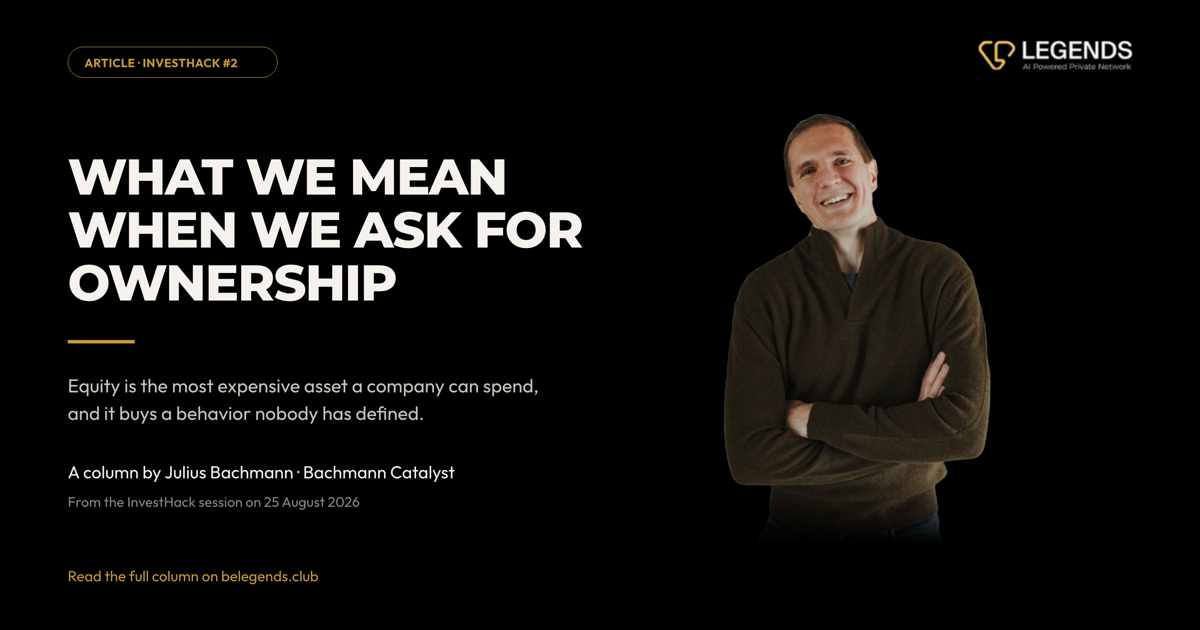
Julius Bachmann is the founder of Bachmann Catalyst, an advisory and coaching practice. He has spent ten years and more than 200 mandates working with the founders and CEOs of scale-up companies, and has a book on ownership and culture coming out. He spoke at a Legends InvestHack session on 25 August 2026.
As an investor and as an advisor, the sentence I hear all the time is that we want the management team to act like owners. I hear it in board meetings and I hear it in coaching sessions. What nobody in the room asks is what we actually mean by it. What is it, in terms of behavior, that we mean when we say ownership?
Ask five people in a room and you get somewhere between five and eight different opinions, because everyone has a different definition. There is no unified, agreed upon definition of what it means to behave like an owner. And to make matters worse, other terms float around next to it, taking responsibility and being entrepreneurial, used in combination, and no one is actually clear what those mean either.
The confusion has a price
In English, ownership does two jobs. When we say ownership we think legal ownership: we own shares in a business, and we use shares to incentivize the people who work in it. What we are looking for when we ask for ownership is a set of behaviors. Same label, completely different things, and they get mixed up all the time.
That would be a semantic problem if it were not so expensive. As entrepreneurs and as owners, equity is the most expensive asset we can spend. Of all the interventions at our disposal when we want to influence behavior in a management team, it is by far the most expensive one we can place. Take the perspective of a venture fund investor, to make it really risk-on: any single one of those businesses has to be able to return the fund, so any percentage point of equity I give away is worth millions of dollars.
So what we are buying is what we think is ownership behavior, but we have not really defined it. And what we are using to buy this behavior we have not defined is a list of behaviors we cannot quite talk about.
The list itself is the easy part
I want long-term orientation, and a perspective that encompasses the entire enterprise rather than one function, whether that function is sales or product or tech. I want discretionary effort that is sustained: we talk about going the extra mile, but I do not want anyone to sprint that extra mile, because I want them to go it for a very, very long time. I want people to proactively identify challenges and act on what needs to be done, whether it sits inside their function or not. I want them to raise concerns and speak up, even when it is uncomfortable. And I want the people I work with to help each other be successful, while holding each other accountable.
Five behaviors. That is the whole of what we are reaching for when we say ownership or taking responsibility.
Shares do not produce them
Between handing someone shares and getting any single one of those five, there is no automatic mechanism. In psychology there is a concept called psychological ownership: the feeling that I own something. The feeling is what produces the behavior.
I am moving cities. We are leaving a city apartment where we lived for three or four years, and moving into a house I know I am going to live in for 10 or 15 years. I arrive with a completely different attitude. I have started to prune the roses, which is not something I would ever have done before in my life. I care about the electricity wires, where in the apartment I would have called the owner and asked him to please fix it. I own neither place. So why am I behaving more like an owner when I am not one?
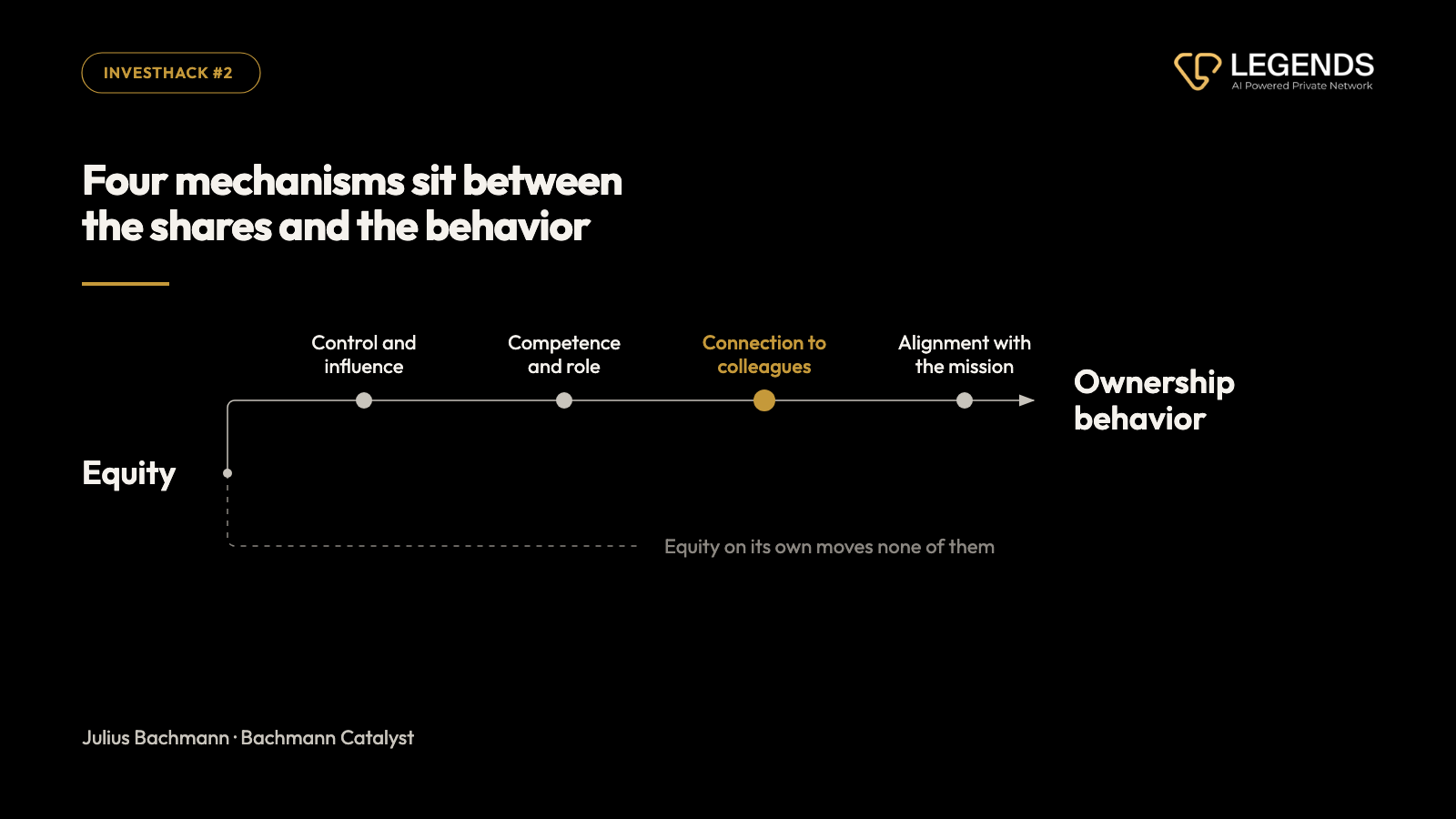
Four mechanisms sit between the shares and the behavior. Do I feel in control of my job, and can I influence the trajectory of the business? Am I competent, do I have the skills, and am I in the right role? Am I connected to the people I work with? And is the mission aligned with mine? Those four mediate everything between equity and ownership behavior, and equity on its own moves none of them.
The cheaper lever
The interesting question is not how to be more generous. It is how much more performance we can get out of the same equity by being smarter about it: 2x, 3x, 5x from the same team with the same shares.
Next to equity there is cash compensation, still expensive, one for one, without the long-term effect, and there is a whole science of how quickly bonuses degrade. It does not scale either: for every single employee a salary has to rise or a bonus has to be promised. Role and team design points at control and competence. Governance and process is largely set in the deal itself. What is left is leadership.
And the one thing I found, about ownership and care being two sides of the same coin, is this: when the mechanism you manage to trigger is connection and relatedness and reciprocity, it is the cheapest way to promote ownership in any team, and it scales, because it happens at peer level.
The mechanics are unremarkable. In a team, I look to my left and to my right and see two people I spend most of my working day with. I depend on their work product and they depend on mine, which is functional interdependence, and because we spend that much time together I would rather not let them down. Accountability at that level rises the stronger the connection is.
I am not talking about the kind of accountability where something has happened and we convene a council to find out who did it and who failed, and then point fingers. That one is backward-looking and organized around shame and guilt. I am talking about positive accountability: I made a commitment, and I am going to do whatever it takes to ship the product or deliver the document or close the financing round, because you and you, you matter to me, and I know you are dependent on me as much as I am dependent on you.
The lever most people miss is an organization that is more interdependent and more connected, one that holds itself accountable and helps itself be successful. It is the same lever, because we are still giving away equity, but the fulcrum is much better.
Vision is not the lever either
The obvious objection is vision, and I am not saying that vision is unimportant. But with 250 employees, every one of those 250 individuals arrives with an expectation of life, a purpose and a value set of their own. It is highly unlikely that a CEO can produce a vision that captures every single one of them. On an 80/20 view of the most effective interventions, that is not it.
Span of care
Someone in the session asked the properly hard version of this: if care is capital, what is the actual return an investor gets from a CEO who runs a high span of care organization?
Motivation runs on a continuum from extrinsic to intrinsic. If the motivational center of work moves toward the intrinsic end, performance rises, because nobody has to be told or incentivized into doing what they already want to do. It is cheaper and it produces higher performance, and that translates into higher enterprise value. The theory underneath is self-determination theory.
There is a limit to this, and I want to be exact about where it sits. I do not believe you can make people care about things, or about work. If you can, it is either coincidence or you are extremely good at manipulating people, and we cannot take that for granted. But people care about other people. That is intrinsically human. And in a company everyone works on the business, so care between people ends up in the business, and it can be measured in enterprise value.
Span of care is the opposite of span of control. When we talk about management we ask how many direct reports I can control, and that question carries an assumption inside it: that these people will misbehave if they are not controlled, that they are fundamentally misaligned because they do not care. Span of care asks for how many of the people I work with I can inspire a sense of care, about the business and about the people in it, so that they intrinsically want to work on what matters for the team. That is the act of the leader, to inspire care.
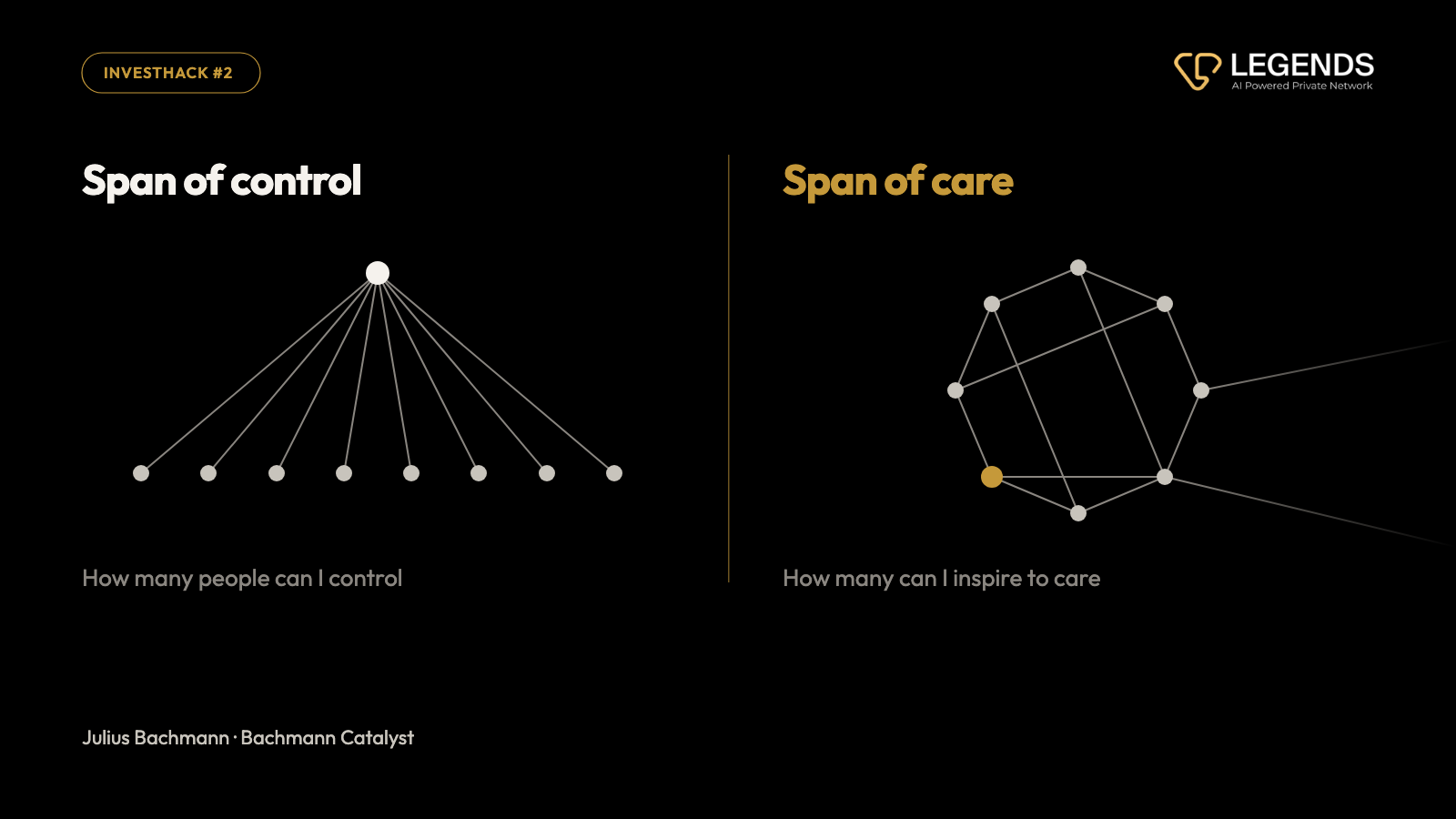
It measures the same way span of control does, by how many people can be included in the sphere of care. What differs is the method. Controlling follows a blueprint; it is industrialized management from the 1960s. Inspiring care is amorphous and takes a different approach from one employee to the next, and it cannot be assessed from outside: it requires knowing what people's motivations are and how they are currently connected, and that requires a relationship first.
Why this gets more important, not less
A lot of the coordinating activity of management is going to be replaced by artificial intelligence. Anything hard cut and easy to measure will be replaced, and so, eventually, will the qualities we describe as fuzzy and human but which are really heuristics, because heuristics are none else than statistics where we do not exactly know the inputs and outputs.
The one thing I do not think can be replaced is where my distinction of leadership begins. Leadership is clarity and care. Care survives because we as humans have a limited capacity to feel. It is innately limited; for a machine it is not. If I direct five percent or ten percent of my care towards one of my employees, that is five or ten percent of my attention and energy and love that I am giving away, mindfully, consciously, because I care, and it means I cannot invest it elsewhere. Care from human to human means something. Care from a machine inflates and therefore devalues.
Trust usually gets named on the same list, and I would put it downstream. Trust is dependability and authenticity, and a model is a black box: we cannot predict how it will behave, because it is a statistical function. Of the core pillars of leadership I would name care rather than trust. Trust is a result of that.
Where the question came from
This did not start in a boardroom. There are two kinds of nonfiction book: the capstone book, where I am the expert looking back on what I have learned, and the explorative book, where I am a seeker with a question that matters enough to spend two years of my life on it, and I am open for the question to change me. I set out to write the second kind, which is why I wrote it myself. A ghostwriter delivered a text early on that was good, and funny, and just not mine, and at that point I did not know myself what I wanted to say. The book stayed at roughly 300 pages, and the middle part I wrote five times, because it kept failing to align with what I truly believed.
The whole line of inquiry about ownership only opened up into care when I realized that we are asking for the same thing at home. Can you please show your care in this or that way, because that matters to me. In the business it sounds harder, can you display ownership, these specific qualities, but underneath, the call is the same: can you please care more, can you care about what I care about, can you care about me? If there is one person who inspired all of this, it is my wife. We can be arguing about who empties the dishwasher and who brings the trash out, very menial jobs, and the question inside the argument is whether I care about all of this, and about her. It is the exact same question we ask in business. We just use different words.
That is when I understood it is a distinctly relational practice.