 LEGENDS
Varun Malik started out in operations at Citi and led operations consulting at PwC Middle East for six years. In 2016 he founded Konsälidön, which he has since pivoted from a consulting platform into a consulting firm and then into a venture studio and a venture fund; he is a Legends Club ambassador. He spoke at a Legends session on 8 September 2026, and what follows is drawn from that conversation.
Someone in the session asked which comes first for an early-stage AI company: strong relationships with the people who already use the product, or the race to build a moat before AI makes it easy to copy. My answer came out fast, because I have been on the losing side of that question. The moat is in distribution. It is in the community around whatever gets built. The product is not where the defense lives.
I did not reason my way there. I built a business whose entire product was the introduction, and both sides stopped needing me. Before that I built one that sold well and ran out of money in a year.
We sold well and counted badly
In 2010 I set up my first business in Delhi. It did not die from a lack of customers. By then I had learned the art of selling, and we sold. It died from cash.
We were running two things at once. One was commercial, business to business, and it made a lot of money. The other was retail, consumer facing, and it carried far more expense than the first one could cover. On a page the two look like a portfolio. In a bank account they are a single number, and that number fell every month while the commercial side kept producing invoices that made me feel fine about it. About a year after I started, the money ran out. Not the pipeline. The money.
Something slower sat underneath that. I grew up in Dubai and lived there almost my whole life, and Dubai spoils people: it is comfortable and orderly, and comfort gets mistaken for the way business works everywhere else. Delhi is rougher. There is pollution, there is traffic, the economy is much larger and the competition is cutthroat in a way I had not priced in. I had made a plan for a market I understood and ran it in a market I did not.
In 2011 I joined PwC.
Two hundred thousand families
I did not go back to the corporate world as a strategy. There was no choice in it. What I went looking for was a roof over my head, and that phrase flatters me: I was never anywhere near homeless. But taking shelter inside something much larger than me until I could stand up again is what those years were.
Entrepreneurs talk about large firms with a particular kind of dismissal. We look at a firm of 200,000 people and call it a factory; I have said it myself. What that sentence leaves out is that a firm with 200,000 employees supports 200,000 families, and that it took roughly a hundred years to get there. Whatever else is true about the machine, that is an achievement, and most founders will never come close to it.
I stayed about six years, and two things came out of them that going it alone would not have given me.
The first was the relationships. The connections I made in those years still work for me at the firm I run now, and I mean people who take the call, not names in a database. The second mattered more. I was leading a team as an individual and growing it inside a structure I had not designed, and I made a great many mistakes doing it — the useful kind, where the cost lands on a large firm’s ledger and not mine.
I do think about the six years I gave away. If I had kept the 2010 business standing all the way to now, the run behind me would be much longer. I began again in 2016, so my firm is coming up on ten years, and those other six would have added a great deal to it. I have no regrets, and I do not think regret is worth carrying about anything a person chooses to do.
The two sides found each other
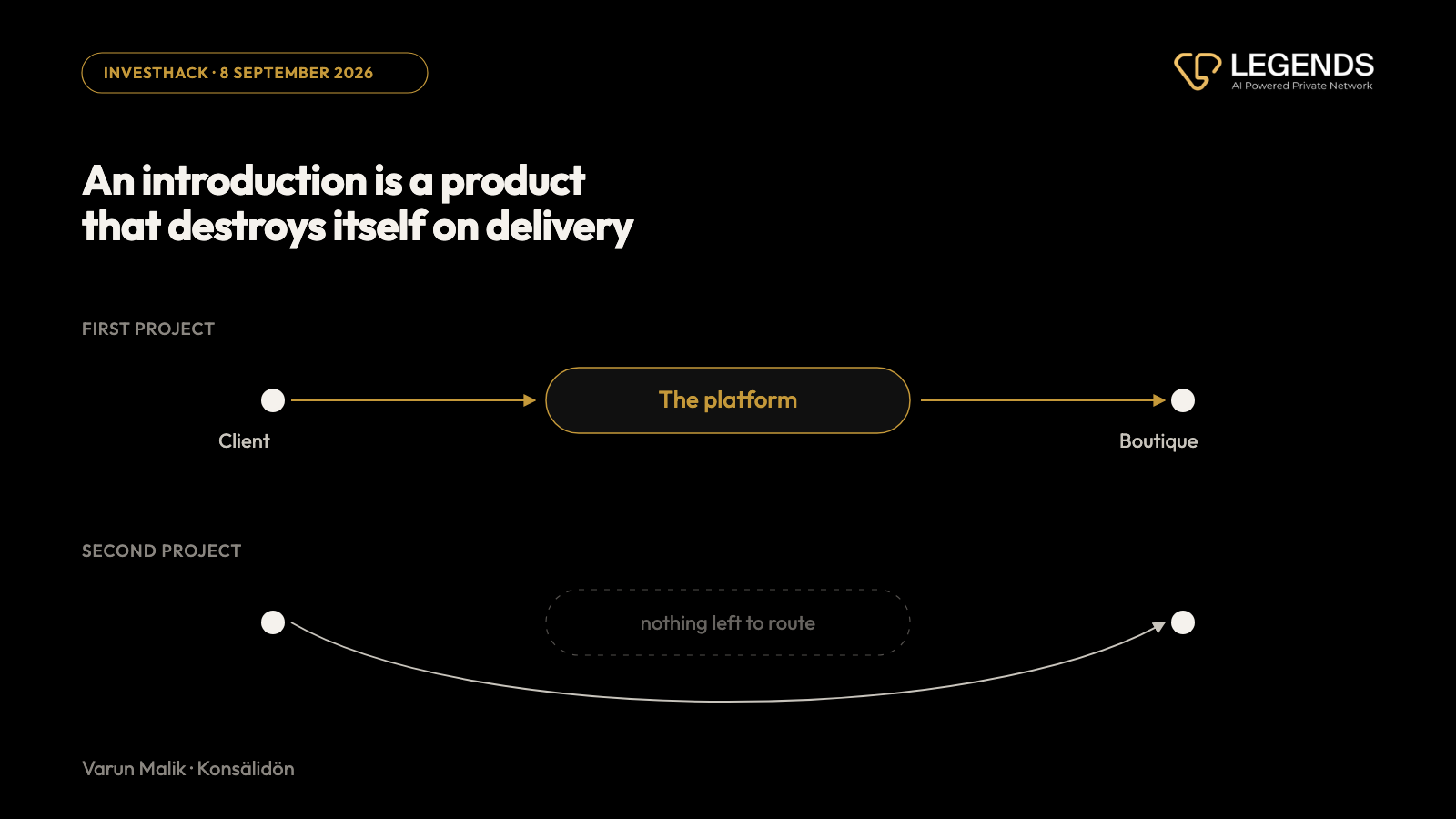
The firm I started in 2016 began as a platform. The model took one line to explain: clients on one side, small consulting firms and boutiques on the other, and us in the middle making the connection. We knew who was good at what. We could put the right boutique in front of the right client faster than either of them could find the other.
What happened next is the whole story. The two sides met through us and then went on without us. A boutique finished the first project well, the client had a second project, and there was no reason left to route it through a platform. We had sold the introduction, and an introduction can be made only once.
I had been warned. Several people told me this exact thing before I started, and I had an answer ready for each of them. It was always the same answer. These are consulting firms. They have spent twenty years in this business. They have the right ethics and the right model. Why would they go around us when we can bring them so many projects?
Every fact in that answer was correct. The conclusion was wrong. They did have the ethics. They also had a client asking for something on Monday and their own people to pay, and nobody in that conversation was thinking about my margin. The warning I was given had nothing to do with the character of the people I had chosen to work with. It was about the shape of the thing I had built. I answered a question about structure with an argument about character, and the structure won.
By then the stakes were not abstract. 35 families were completely dependent on me. I had hired almost 20 people right before COVID started, which is not an easy mistake to make, and 2021 and 2022 went into digging out of it. So we pivoted, many times over. We stopped being the middle and became the consulting firm ourselves, contracting with clients directly and subcontracting to the boutiques: more stable, less scalable. Then a venture studio and a venture fund, which is where my attention goes now.
The short version, for anyone building a marketplace: an introduction is a product that destroys itself on delivery.
Two kinds of companies
Someone else in the session ran a consulting company and asked how much budget to put into AI. My answer was to stop thinking about being a consulting firm at all. There are two types of companies in the future: the ones that are AI native, and the ones that do not exist. For a services business that means the kitchen is AI. An AI native company can look like a consulting firm from the outside; the reverse does not work.
I say that about my own industry first. Consulting is a sunset industry now. Ten years ago the graduates coming out of good universities would fight to get into investment banks and consulting firms, then the same people started moving toward big tech, and now even big tech is not the prize it was to them. I watched demand drain out of the thing I sell, in the market where I sell it, and that is a large part of why I started studying the future instead of assuming it.
Then the mechanical part, which is what moved the moat. AI is getting cheaper. Computing is getting cheaper. Both will keep getting cheaper, and I do not think there is anything left that AI will not be able to build. A person who can state a problem clearly and has real experience in the domain will get a working version of almost any product built, and the distance between that version and a funded one is measured in weeks.
That is not the end of it either. Generative AI and agentic AI are the part of the iceberg above the waterline, and there are several other icebergs behind it: quantum computing, spatial computing, space technologies, decentralized money. Anything built on the tools available this year is something I will be rebuilding.
So when a founder asks me whether to race for a moat before the copying starts, the honest answer is that the race is already over. Nothing that can be built stays defended by having been built first.
No one has relationships with three hundred thousand people
If the product cannot be the moat, distribution is, and for me distribution means community. That word gets used loosely enough to mean nothing, so I keep numbers on it: the numbers are what turn it from a sentiment into a plan.
I think of the people around what I build as five circles, each roughly a tenth of the one outside it.
The outer circle is 300,000 people. That is my own goal: an audience of about that size who read what we publish and follow what we do. Inside it sit 30,000 people who transact with us commercially. Inside that, 3,000 who come through our learning programs. Inside that, 300 people we build with, co-builders on real products. At the center, 30 people who put money into what we make.
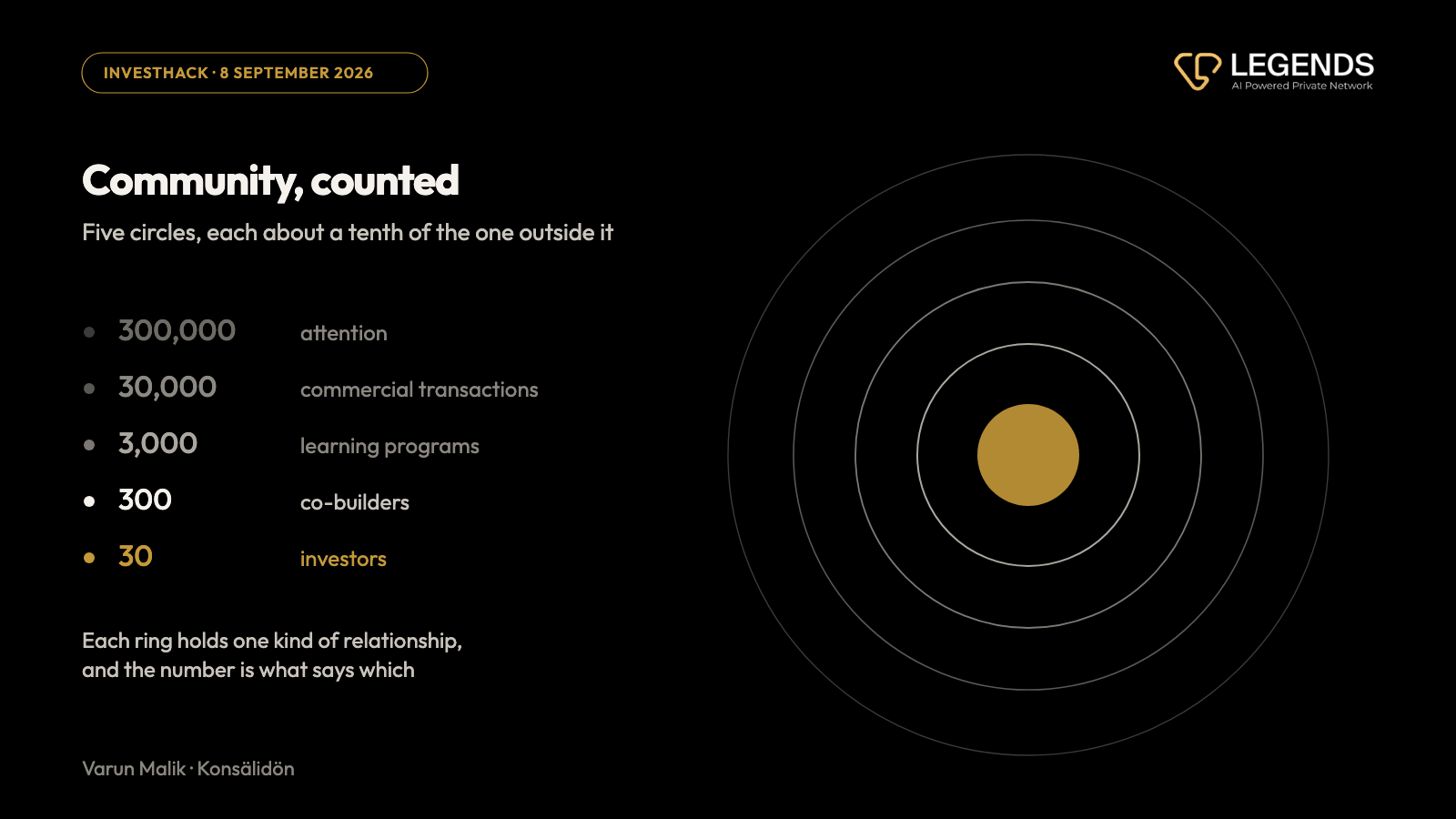 Five circles, each about a tenth of the one outside it: attention, transactions, programs, co-builders, investors.
The reason I hold the numbers and not only the word is that each ring holds one kind of relationship, and the number is what tells me which. No one has relationships with 300,000 people. That is not a question of effort or of caring enough; it does not exist. What 300,000 can give is attention. With 30,000 there is a transaction. With 3,000 there is a room and a program. With 300 there is something built together. With 30 there is a phone call that gets answered. Each of those is real at its own depth, and each one is fed from the ring outside it: the thirty came from the three hundred, who came from the three thousand.
We run the funding side the same way. Entrepreneurs come to us as employees first, into our own startups, and we watch how they operate; the entrepreneurial ones get the funds to set up their own business. Nobody arrives at the center.
Where I would start now
If I were starting again with what I know today, the product would not be first.
I would start at the inner rings, because they are the only ones that can be built without an audience. Thirty people who would put money into a thing and three hundred who would build it are conversations, not campaigns, and one person can have all of them inside a year. The outer rings are slow, and they are the ones founders try to buy first, which is the wrong order. An audience of 300,000 around a product that nobody in the middle rings has pressure-tested is an expensive way to find out the wrong thing got built.
Then the product, and here is the part founders resist hearing. It gets rebuilt. Not because the first version was wrong, but because the tools underneath it will be different and cheaper. Building on generative or agentic AI right now is the correct move, and relying on that alone is not: the phase I see coming is what I would call augmented understanding, collective intelligence rather than a model answering a query. The cost of rebuilding keeps falling. Not rebuilding is the expensive decision.
Understanding the circle is what makes the rebuilding possible. Knowing the thirty and the three hundred means knowing what to change when the tools shift again. Knowing only the 300,000 means getting a number that says something moved, with no idea what to do about it. A community is not an audience for the product; it is the instrument that shows what the product becomes next.
One rule, and I repeat it to myself. In 2016 I answered a question about structure with an argument about character. I do not do that now. When someone tells me there is a hole in the model, I stop defending the people inside the model and go look at the hole.
Varun Malik spoke at a Legends session on 8 September 2026. The open session ran first; the closed room afterwards was for members only, and membership starts with an interview.
About Legends. Legends is an invitation-only, AI-powered private network for the people who move markets — founders, operators, family offices and investors who prefer to build among peers rather than crowds. One network, three clubs: the Global Investors Club, the Global Founders Club and the Global C-Level Club. Different rooms, one standard to enter.
Legends is not an investment platform. We do not sell deals, take commission or give investment advice.