 LEGENDS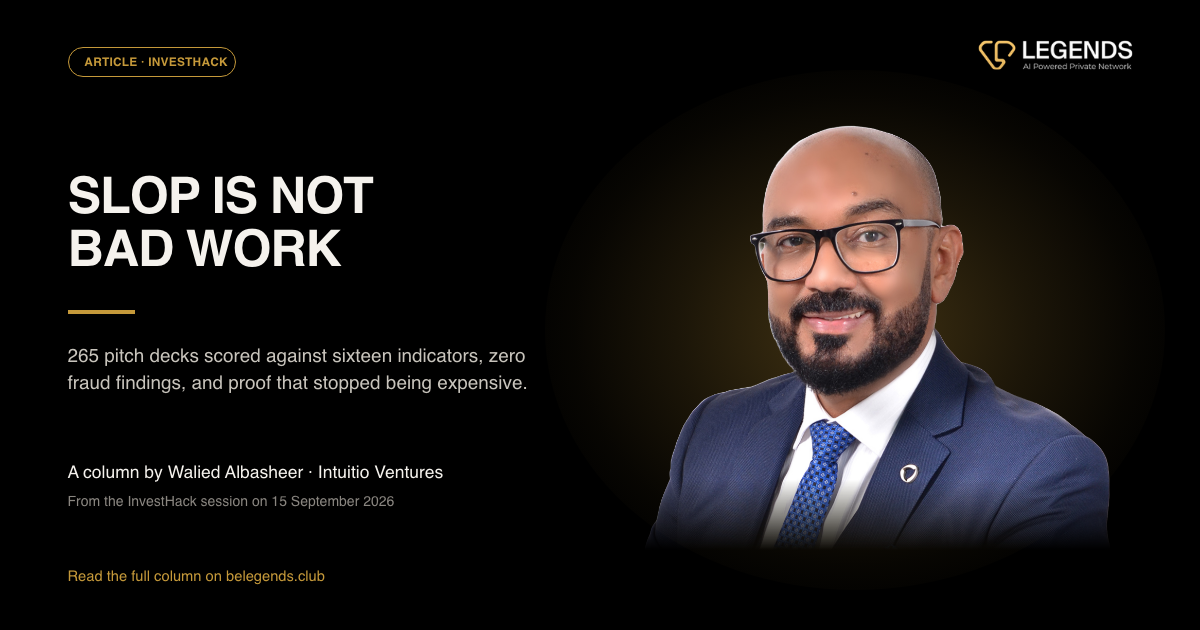
A machine once wrote my profile. It was a good profile. It said I founded my company in 2015. I founded it in 2011.
Nobody was careless and nobody lied. Four years were scrapped out of a company’s history because the output was the most probable version of me that the model had been exposed to. That is the thing I want to be precise about, because the word we use for it invites the wrong conclusion. Slop is not bad work. It is competent work: a sanded-down, sourceless version of something true. It takes a handful of facts, finds the gaps between them, and fills the gaps by guessing.
There is a photograph of me in a suit and shoes I have never owned. A studio would have charged a couple of hundred dollars for it; it cost a few thousand tokens. Nothing in it is a lie anyone could point at. It is not real.
I have spent the last few months scoring the pitches that arrive at my fund. My conclusion is not that founders became dishonest. It is that what investors read as proof for fifty years stopped being expensive, and the proof went with it.
The hour that cost half my month
In the summer of 1996 I was a student in Pune, in my final year, studying geographic information systems. We lived around Koregaon Park, near the German Bakery, where the foreign students gathered. A friend told me over evening tea that there was something called the internet and I had to see it. I could not pronounce it properly. I kept saying intranet.
He sent me to a place near the university. Half an hour cost about 1,500 rupees, a full hour two and a half to three thousand, around fifty dollars, when I lived on roughly a hundred dollars a month. I paid for the hour. There was no Google and no Yahoo; there was Excite, and there was AltaVista. My first search was Cindy Crawford.
I never regretted it. We could not keep paying for it, so we made ourselves useful to the cafés and brought our friends in: in India everything shuts at eight, and a few dozen foreign students with nowhere to go turned an internet café into a social club.
The person who taught me most in that room was called Shafiq. He was an orphan who cleaned the place. Because he was there all day, he learned everything: restarting a frozen machine, troubleshooting a dropped connection, mIRC, USENET. He taught the students. He taught me.
No model summarizing my career would find Shafiq. He was instrumental, and his life does not survive being summarized. I think about that whenever someone shows me a perfectly composed account of a company: what is missing from it is exactly the part that was never written down anywhere for a model to read.
Some of what I started since then worked and some did not. Techoz sold hosting to agencies from 2004 until the cloud commoditized it. Formula World Sports came out of the President’s Cup here in the UAE and grew into a world championship series, ten or fifteen races a year from Kota Kinabalu to Riga, until the 2009 crisis took its sponsorship. Neither closed because the business model was wrong. Sometimes a thing is simply too early.
Proof used to be expensive
For fifty years a founder showed an investor things that were costly to produce: primary research, secondary research, a prototype. The value we assigned to a venture was a function of how much time and difficulty the evidence had taken. Founders raised at the earliest stage largely to hire the engineers who would produce it.
I went through that system myself. On the Steve Blank school of lean startup, which we mentored on for years, the weekly discipline was twenty to thirty objections before the next sprint: standing outside a Walmart, asking people leaving whether they would buy this, writing down every no. Objections are gaps, and a closed gap brings the product nearer the customer. It took months and real money.
Today ten minutes of deep research in a frontier model returns more than we gathered in six months. Iteration count was a signal for a while; now a founder runs a hundred iterations a day while the model underneath ships four or five updates during the same session.
The numbers moved the same way. Between 2019 and 2021 an MVP cost somewhere between forty and a hundred and fifty thousand dollars and took three to nine months. Today a working one is built through Replit or Lovable for fifty, a hundred, two hundred dollars, in days, and it is often better than what that money used to buy in 2019.
Generative AI did not devalue a specific signal. It made the artifact cheap: the prototype, the deck, the landing page. Every signal we had been reading off those artifacts came down with it. The share of false positives in my inbox is high enough now that the first read tells me almost nothing.
Four gates
So we stopped reading the artifact and started reading through it, in four layers with four indicators each.
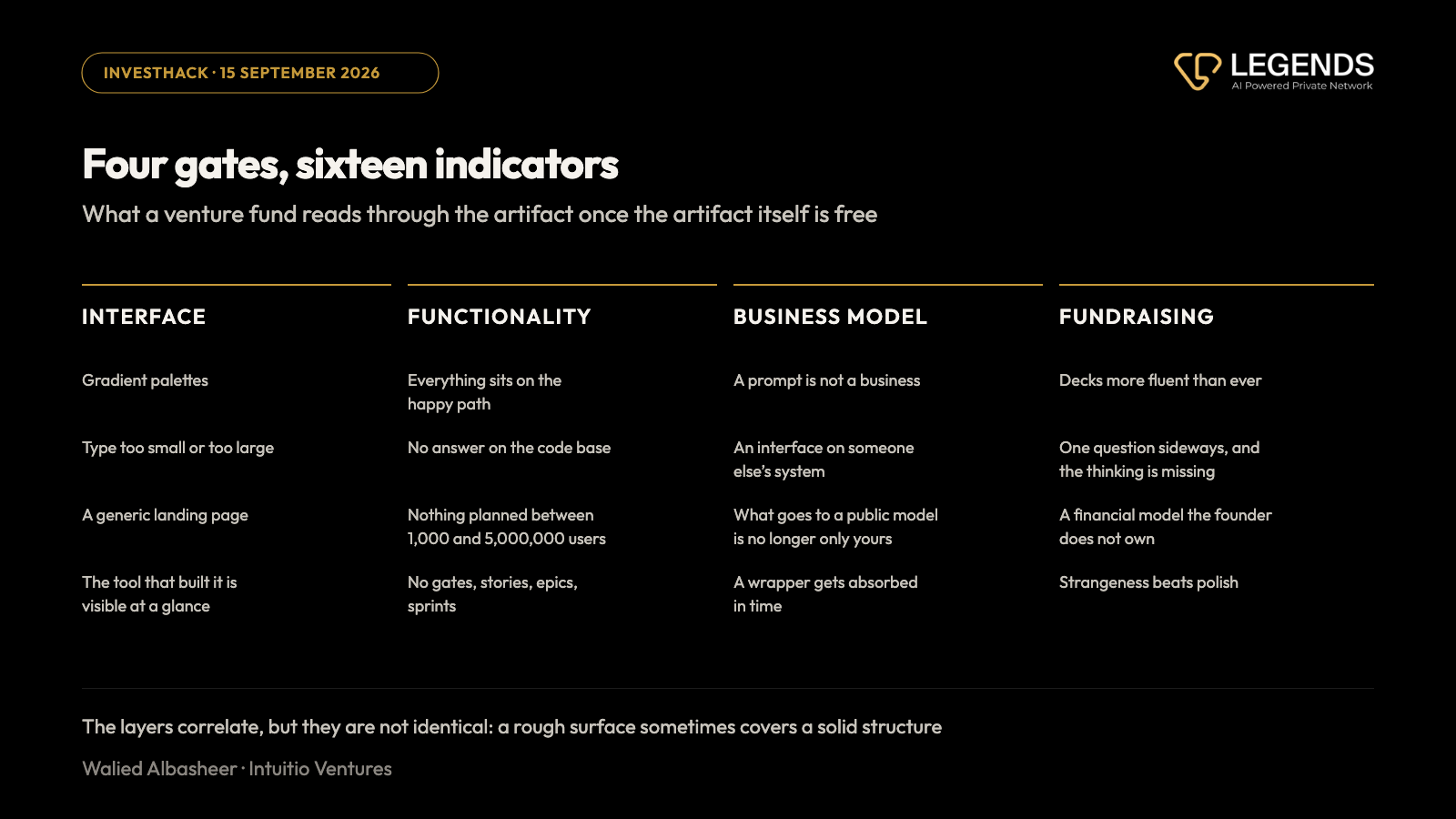
The interface. The gradients, the typography either too small or too large, the generic landing page. Anyone who looks at products all day can now name the source: this is a Lovable one, this is a Claude one, this is a Replit one. Detection is cheap here and so is the fix, which is why the better founders make it first.
The functionality. Everything demonstrated sits on the happy path. A founder asked to walk through the code base often answers that the question does not matter, it works. It works for a thousand users. At five million it matters which architecture it was built on and whether anyone can operate it. Part of our technical diligence is now simply whether a team works to a structure at all: version control with gates, stories, epics, sprints. One trap is worth naming: a domain bought through the tool that built the product does not always belong to the founder, and a domain is a brand.
The business model. A prompt is not a business. An interface sitting on somebody else’s system is not defensible, and anything wrapped tightly around a frontier model gets swallowed by it in time. I have watched teams build a voice product for a language the models handled poorly, using those same models to do it, handing over their advantage in the process. What a founder shares with a public model is no longer only theirs: not the data, not the approach, not the idea. And when a new version ships and the advice is to clear out the skills and plugins built for the old one, that advice is worth reading closely. If five hundred legal experts each encoded a lifetime of judgment into a workflow and those workflows are now one feature, the expertise was not deleted. It was absorbed.
The fundraising. Decks are more fluent than they have ever been. One question sideways from the deck, and a founder who did not build the thinking is lost. The founders I back own their numbers. A beautiful and complicated financial model can be generated in an afternoon; whether it belongs to the person presenting it is a question about trust, not about spreadsheets. I sat in an office hour with Tim Draper once, where he said that any founder who brings him something genuinely strange to him gets his money on the spot. After enough pitch decks, the strangeness is the moat.
The layers correlate but they are not identical. A beautiful surface can sit on a hollow structure, and a rough surface sometimes covers a solid one. That is the reason to look at four gates instead of one.
What the inbox showed
We scored what came in. About three hundred ventures reached the form; two hundred and sixty-five were scored once duplicates and half-finished entries were set aside. Sixteen indicators each, around sixteen hundred individual pieces of evidence. Slop density across the material ran between roughly a quarter and a third.
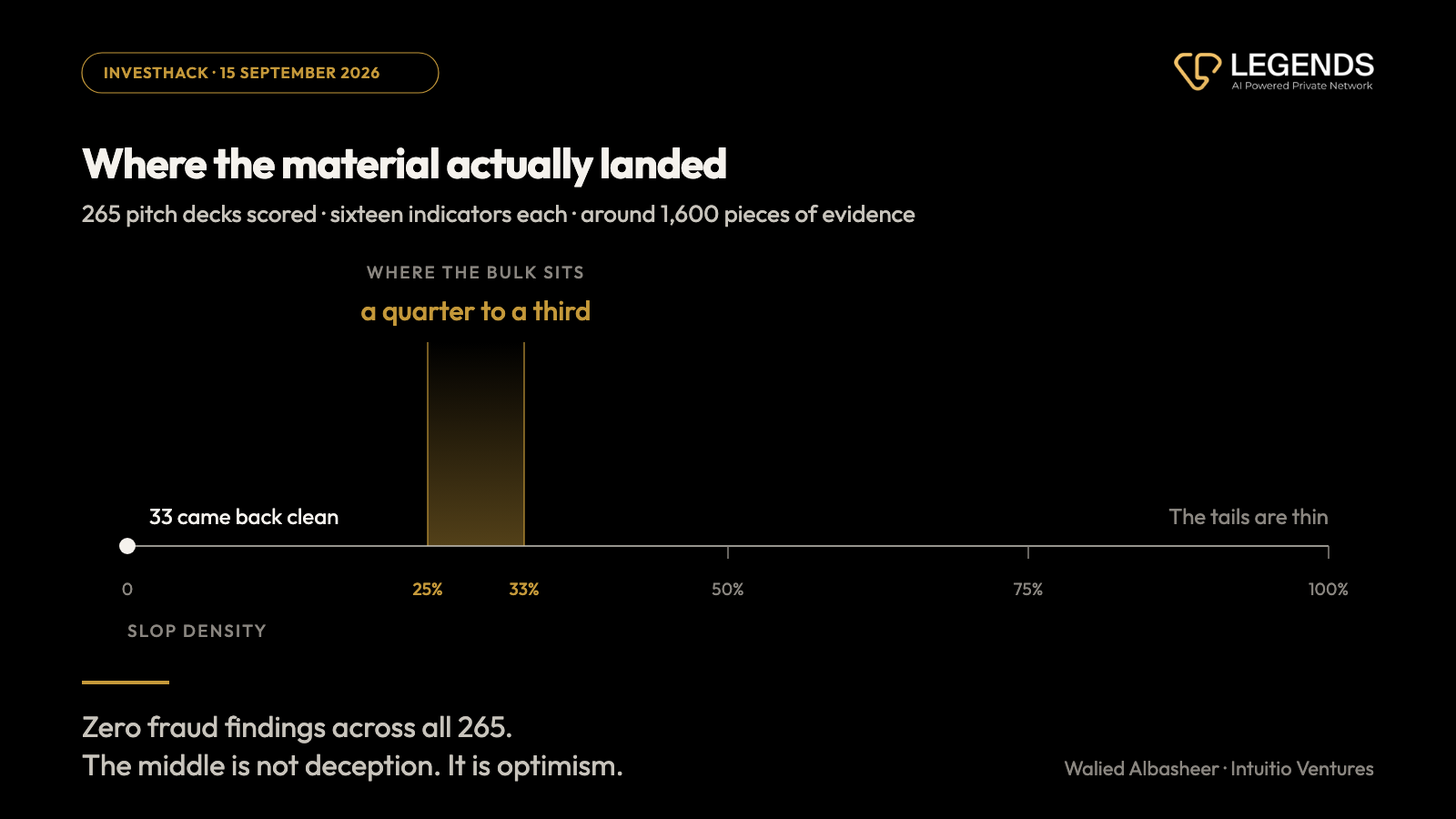
Zero fraud findings. Not one. Whatever this is, it is not a crime wave.
Thirty-three of those pitches came back clean, about ten percent of the inbox. The interesting part is neither that end nor the extreme one. At maximum density it is hard to believe the intention was good. But the bulk of the distribution sits in the middle, and the middle is not deception. It is a founder who trusted a confident answer. It is optimism. It is one co-founder playing devil’s advocate against another who is certain: healthy in a team, and invisible on paper now.
We also scanned the material founders share more broadly, five hundred and eleven items, and two hundred and forty-three showed no defensibility at all. Close to half. That does not always mean a venture is finished, but the window is closing: translation, graphic production, a friendlier surface over a spreadsheet. What was valuable because it was pleasant is repricing, because the pleasantness is free. Hardware, once a reason to pass, is a moat again for the same reason: it cannot be duplicated in an afternoon.
What did not get cheap
If the artifacts no longer carry the signal, something else does, and for me it is behavior.
In 2007 Dave McClure published the pirate model: acquisition, activation, retention, referral, revenue. I think he accidentally wrote the anti-slop checklist, because behavior is the one thing generation cannot produce. Acquisition can be manufactured. Activation is the moment value actually moves: someone buys once, on purpose. Retention means they came back. Referral means they told someone else. None of that can be prompted into existence.
Someone asked me for a real example of a two-hundred-dollar MVP becoming a real company. The MVP is not the point. I mentored with Mudassir Sheikha and Magnus Olsson in the early days of Careem, a three-billion-dollar exit, and at the start they had no product. They had a WhatsApp group of drivers, and when a driver did not answer they collected the passenger themselves. Activation, retention and referral, with no acquisition tool in sight. A thing built in Replit that can take a payment will carry a founder to five hundred customers before anything needs refactoring.
This is what I mean by preferring low surface and high core to the opposite. A polished surface over a shallow problem is where the money has been going; the depth of the problem is where the returns are.
There is a question of integrity underneath all of this, and I was asked it directly. A CFO will not offer to cook the numbers; he would lose his license and his standing. A frontier model will offer, shamelessly, and it carries no accountability at all. The integrity of a founder is one thing. The guardrails around the founder are another, and right now the second one is missing.
What I look at now
Premature scaling is still the main reason startups fail, and agents make it feel possible to run three cities and two segments at once. The ones who survive master one segment, one geography and one customer base first.
A surface-level AI company, in my estimate, has about three funding rounds of relevance in it, thirty-six to forty-eight months. So I ask founders the only question I really ask myself: whether they will still be excited about this in five years, and who could buy it in 2030. Startup funding in this region in 2025 was three point eight billion dollars across six hundred and eighty-eight deals, and the technical diligence capacity to ask that is not there in many of those funds. Capital was never the success factor, and it is less of one now.
One last thing, and it is not advice about tools. A spelling mistake has become a valuable marker. I am not telling anyone to make spelling mistakes. I am saying the signals have inverted so completely that evidence of a human being present is now the scarce thing, and most founders are sanding it off. The part of a company that does not survive being summarized is the part I am looking for.
Shafiq is the part of my story that no summary of it has ever contained.
Walied Albasheer spoke at a Legends session on 15 September 2026. The open session ran first; the closed room afterwards was for members only, and membership starts with an interview.
About Legends. Legends is an invitation-only, AI-powered private network for the people who move markets — founders, operators, family offices and investors who prefer to build among peers rather than crowds. One network, three clubs: the Global Investors Club, the Global Founders Club and the Global C-Level Club. Different rooms, one standard to enter.
Legends is not an investment platform. We do not sell deals, take commission or give investment advice.