 LEGENDS
Vijay Sivaram was part of the founding team at Quess Corp in 2007 and CEO of its IT staffing and recruitment business; he is now co-founder of RVAI Global, the AI company he leads. INSEAD MBA. He spoke at a Legends InvestHack session on 11 August 2026, joining from an airport between flights; what follows is drawn from that conversation.
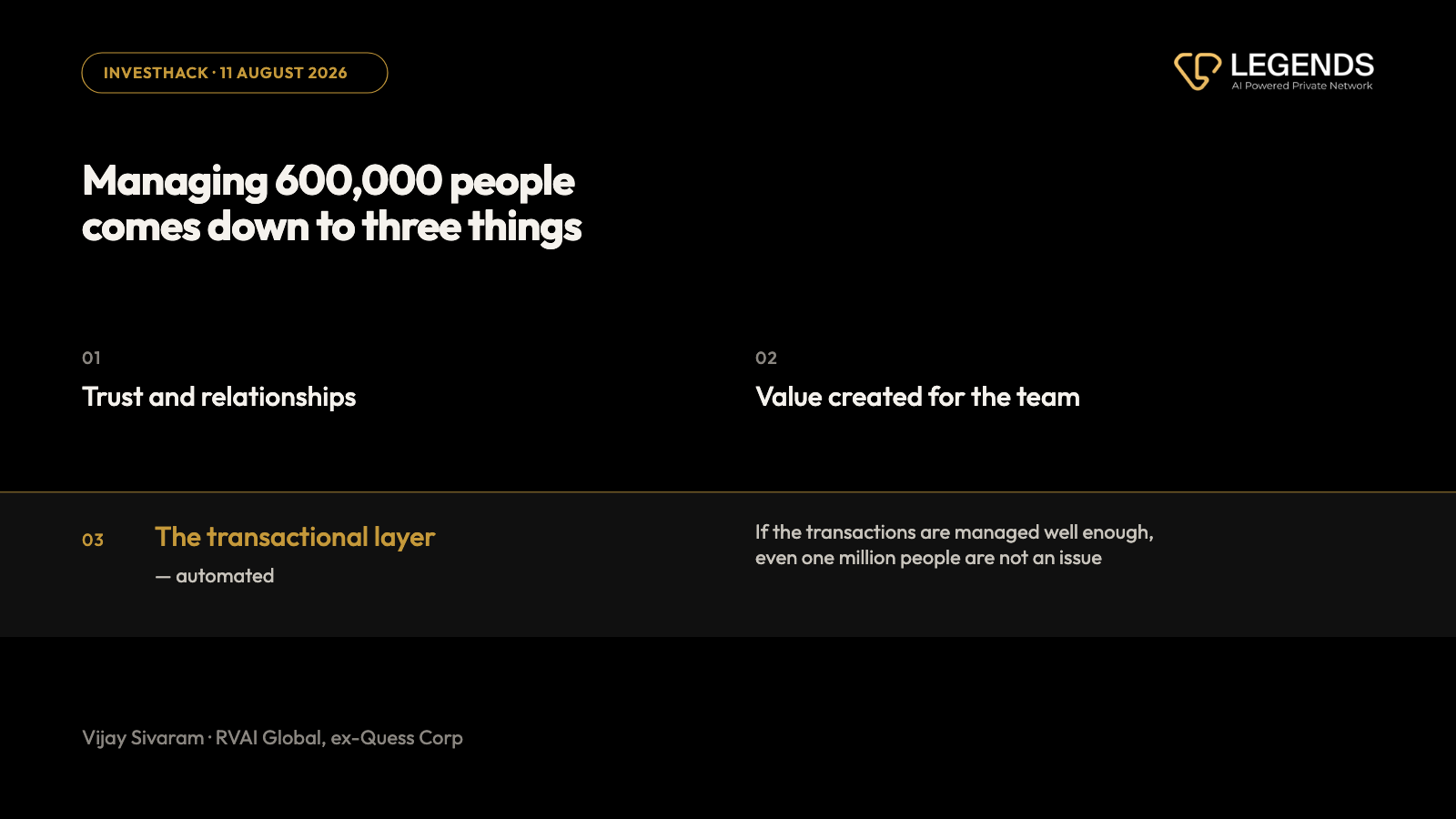
The question I am asked most often is how anybody manages 600,000 people. The answer is expected to be about layers of management, or the systems underneath them. It is neither. Managing large teams, at any size, comes down to three things. The relationship and the trust I have with my teams. The value created for them. And the transactional world underneath, which exists so that the first two stay in focus.
The third one decides the other two
Trust and value are the work. If we manage the transactions well enough, even one million people will not be an issue, because the focus stays on the first two and the transactional world runs itself. We automate all of it, so that when somebody needs something, we are there for them.
It was never the size that mattered for us. It was how we built the relationships.
What we were actually selling
The company I was part of was built on one construct: outsourcing as a service. We used to work with global organizations, helping them outsource work, outsource technology, or even outsource staff. If a piece of technology was not core to a client, I would build it and maintain it for them.
I have always put it this way: what is not core to a company, I make it my core. Which means the transactional layer was never a side concern for us. It was the product.
Three decisions
There were many decisions along the way, and plenty went both ways at once. Three changed the trajectory.
We started in 2007, and at that point we decided that the strongest asset in any company is its people, and that we belonged in the business of managing, deploying and orchestrating them. From that point we circled ourselves with anything to do with people and talent.
The second was to grow both ways at once. We never grew only organically; we kept a constant lookout for acquisitions, which built synergies into the enterprise and made it more focused on the customer.
The third was to use technology to carry all 600,000 people. Every decision circled around people, technology, and growing aggressively at every point in time. Slowing down was never one of the options on the table.
The acquisitions that did not work
We acquired companies to add qualitative value for the customer, not only to the top or the bottom line. Sometimes I would love a company and align well with its leadership, and only after the acquisition closed start to realize that the culture and the way they operated were very different.
I would not call those decisions expensive. Delayed is the more accurate word: we always worked out a plan to turn the thing around.
The people are the harder part. Some of the ones who started with us could not continue with the vision we were building and chose to part ways, and I do feel bad about it, because the company went on to do well. A good number started companies of their own, which I read as credibility to the people we had.
Why I stopped being an angel
I never left the company. In 2016 it listed on the Indian stock exchange, our shares became liquid, and India was going through a huge startup boom. I came across companies I loved and started investing as an angel. I enjoyed it: I have always been a sales-led CEO, so the part I like is helping founders get things done.
As the portfolio grew, I could no longer give each company enough research. That is why I moved to being a limited partner in 2022: a private equity or mid-market fund has a research team, an analysis team and a clearly defined thesis. Today I act as an LP and do very few angel deals.
I follow some basic rules, and they are mine alone, with no claim to being right. One person on the leadership team comes from the domain. And there is clear visibility on the road to profitability: not achieved, visible, with the logic of how they get there.
Choosing a fund comes down to three things. Who runs it, because these are not small tickets and it is other people's money. The what-if scenarios: what if the thesis goes this way, what if artificial intelligence comes and spoils the party. What I am listening for there is how far the team has gone into its own thesis. And the culture of the fund: honest, stable, focused. It is not only about good exits; it is about an ecosystem of companies that can consume each other's benefits.
I am an agnostic investor, with one exception: I stay away from space tech. I know it is a great space, and I have simply never come across a company in it where I felt convinced, usually because I could not see that road to profitability. Maybe the way I look at it is wrong.
The one I lost
I invested in a media analytics company. I really was impressed by the team, and I still think the leaders are fantastic. They struggled on their go-to-market strategy, and the media segment was so niche that it was tough to crack. I had not accounted for that. They eventually shut down.
What I took from it was not about the sector. I wish I could have helped them, and I was not aware they were going through a difficult stretch until it was too late to use my connections. Angel investments do not necessarily keep an investor updated on a regular basis; LP investments always do. I had invested in quite a lot of companies and I lost track, because I was working.
Now I make it a point to ask for a report at least once a quarter.
From arbitrage to ownership
One of the most exciting things happening in India, the Philippines, Mexico and Latin America right now is the GCC. For anyone reading this from the Middle East: not the Gulf's GCC. Here it stands for Global Capability Center, a tech center that keeps its parent organization ahead in technology.
The term is new. The thing is not. India has always been one of the largest producers of engineering talent in the world, with close to 1.5 million engineers coming out every year, and in the early 1990s that produced cost arbitrage centers: call centers and outsourcing units running finance, HR and back-office operations for the world.
Then technology arrived, in stages. First support and maintenance: a Dell laptop stops working, somebody dials the 1-800 number, and the call lands at a desk in India. Then the knowledge process hubs doing research, analytics, data science and application development, which turned the cost center into a technology and a process center. Around 2018 and 2019, new products started to come out of India, along with the digital transformation work everyone wanted at the time. And now the centers that transform their parent enterprise are becoming AI-native: the artificial intelligence itself is built in India or the Philippines and delivered to the global organization.
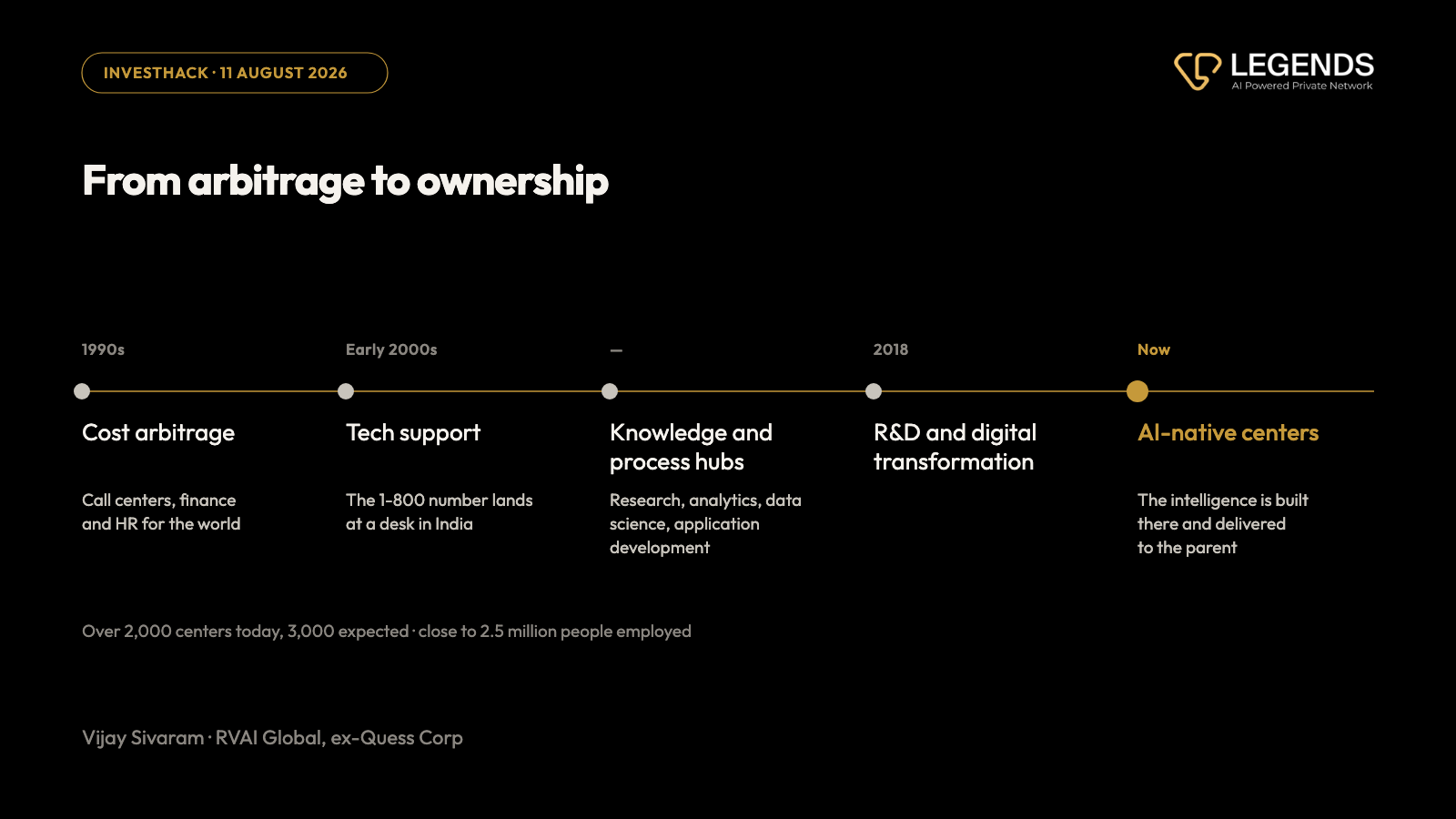
Three things carried that whole arc, and the same three carry it now: the quality of the talent in these countries, the cost at which it comes, and the quantum of it.
Where it stands today: over 2,000 centers, and we are expecting this to become 3,000. Each tech center manages close to 2,500 to 3,000 people in India who support the globe, and close to 2.5 million people are currently employed in this space. There are close to 100-odd centers that open up every year. A walk down one street in Bangalore passes Google, Adobe, Goldman Sachs, Barclays and Standard Chartered, and individual Indian states now compete with each other to invite more of them in.
Three reasons boards do it. A Fortune 500 or Fortune 1000 company wants to stay ahead of the curve, which makes centralizing tech and process important. It wants the front of the office, the people who handle customers, spending their time on customers and product rather than worrying about process. And every time technology shifts, it needs one center that adapts and moves quickly, instead of thirty conversations with thirty different people in thirty different countries.
That is now an investment story of its own. A lot of global real estate companies are coming and setting up base, providing the large infrastructure these offices demand: half a million to a million square feet. With artificial intelligence coming into play, large technology companies and data centers are all starting to come, and there is a huge play on talent and employer-of-record companies. The large players also fund young ones directly: Accenture, for example, runs an Accenture Ventures arm in India that invests in startups to support its global needs.
It has moved from arbitrage to ownership. Same three letters, a different business.
Where AI implementation goes wrong
What I do now is lead an AI company that helps large enterprises reimagine themselves in a world of artificial intelligence. When a company raises an invoice, sends it to a customer and collects the money, a great deal of that can be done by an agent today.
The biggest mistake people make in implementing artificial intelligence is that they do not understand it themselves. A lot of people think that having a great co-pilot or a great cloud account makes them AI savvy. Generative AI answers a query and hands the answer back. Agentic AI takes a process and completes it. Those are not the same purchase.
The second biggest mistake is not knowing what the deployment is for. There is so much fear of missing out that companies implement first and decide later. Banking is a highly regulated industry, and the customer identity check, KYC, is a process inside it that already has a way of being done. Before putting artificial intelligence into that process, the question is what comes out: a shorter time to complete it, a better experience for the customer, or lower cost? Once that is settled the build is far smarter. Just plug and play does not solve it. Regulated or not, the technology can handle it today; what it takes is a partner and a system, not a deployment made out of FOMO.
The method itself is not complicated. We split the process into three parts: how many steps there are and what decisions get made inside each step; where the human intervention sits, whether that is uploading a document, comparing two documents or asking for certain data; and the data layer, where data comes in and where it goes back. Then the process is reimagined with agents. The agent retrieves the document from the folder instead of a person; the agent compares the RFP responses from ten different vendors, under rules we build for it. Human intervention comes down, the decisions are handed over with the rules written out, and confidentiality and governance are managed at all times.
One more thing, because it changes how these projects get priced. The cost of developing software is not high anymore: building software is easy, and all of us can build software together. What is hard, and what still takes a real partner, is quality software.
The rule I repeat
If I could warn a founder about one thing while they scale, it would not be hiring and it would not be capital.
Never lose sight of sales. When sales go well and a lot of customers sign up, the attention moves to delivery and operations for those customers, and the new business quietly stops coming in. It happens to a company that is one year old and to a company that is thirty years old.
As the founder, as the CEO, every single day there is a metric in front of me that talks about sales. Without it, none of the rest works. Great customers today will walk away or reduce what they spend, and the selling never stops.
Vijay Sivaram spoke at a Legends InvestHack session on 11 August 2026. The open session ran first; the closed room afterwards was for members only, and membership starts with an interview.
About Legends. Legends is an invitation-only, AI-powered private network for the people who move markets — founders, operators, family offices and investors who prefer to build among peers rather than crowds. One network, three clubs: the Global Investors Club, the Global Founders Club and the Global C-Level Club. Different rooms, one standard to enter.
Legends is not an investment platform. We do not sell deals, take commission or give investment advice.